

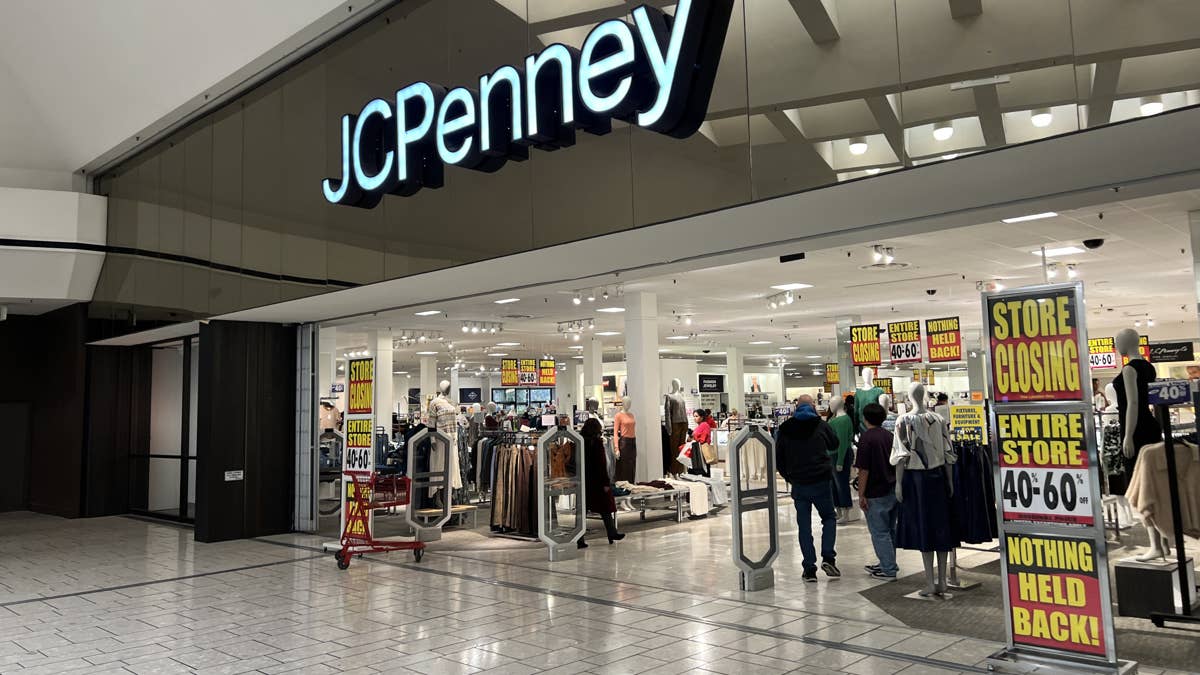
Popular mall retailer continues closing stores in 2026
For 124 years, a well-known department store has been a familiar presence in U.S. shopping malls, serving generations of customers.
But the retailer has undergone a dramatic transformation in recent years, closing hundreds of stores, navigating bankruptcy, and changing ownership as it adapts to a rapidly evolving retail landscape.
Now, another longtime location has disappeared from the chain’s footprint, underscoring just how much its once-expansive store network has changed.
JCPenney continues store closures in 2026
JCPenney has closed its Ross Park Mall store at 1006 Ross Park Mall Drive in Pittsburgh, Pennsylvania, after nearly 40 years of serving the community.
The shutdown comes after the company was unable to reach an agreement to continue its current lease terms and could not find a suitable alternative location nearby.
“Regretfully, we are unable to continue our current lease terms for this store location and have been unable to find another suitable location in the market,” a JCPenney spokesperson said in an email to the Pittsburgh Post-Gazette.
“We are grateful to our dedicated associates and the loyal customers who have shopped at this Pittsburgh, PA, location through the years, and we hope to continue serving them throughout our nearly 650 stores nationwide and at jcpenney.com.”
The Pittsburgh closure illustrates the pressure facing traditional department stores as retailers reassess the costs and long-term prospects of individual locations.
Recent JCPenney store closures
The Ross Park Mall closure is not the only JCPenney store to shut its doors in 2026. The company has also closed several locations nationwide during the year, including:
- 1500 Stoneridge Mall Road, Pleasanton, California 94588
- Seminole Towne Center, 10 Towne Center Circle, Sanford, Florida 32771
- Ford City Mall, 7601 S Cicero Ave., Chicago, Illinois 60652
- Rivergate Mall, 1000 Rivergate Pkwy. Ste 3, Goodlettsville, Tennessee 37072
- Springfield Town Center, 6699 Springfield Mall, Springfield, Virginia 22150
The shutdowns follow a broader contraction of JCPenney’s store network since 2020.
JCPenney’s store locator listed 640 stores as of Sept. 21, 2026. That represents a substantial reduction from the 846 locations the retailer reported to the Securities and Exchange Commission (SEC) at the beginning of 2020, when the company’s stock was still publicly traded.
JCPenney’s bankruptcy and restructuring
JCPenney filed for Chapter 11 bankruptcy protection in May 2020 and announced plans to close more than 242 stores.
The company cited the Covid pandemic as a major factor in its bankruptcy filing, although it had struggled to generate consistent profits for nearly a decade before seeking court protection.
Here’s some of my previous coverage of recent store closures:
- Nostalgic mall staple closes 14 stores amid major changes
- Victoria’s Secret closes 38 stores as customer tastes change
- Discount retailer closes stores in several states
As part of its restructuring, JCPenney secured $450 million in debtor-in-possession financing to continue operating while reorganizing its business.
The retailer was ultimately acquired by Simon Property Group (SPG) and Brookfield Asset Management (BAM) for $1.75 billion. The transaction transferred ownership of JCPenney’s retail operations while separating many of its real estate assets.
Copper Property was created during the restructuring to assume ownership of 160 retail properties and six warehouses. Managed by an affiliate of Hilco Real Estate, the trust was tasked with owning, leasing, and ultimately selling those assets.
Newmark, the commercial real estate firm representing Copper Property, previously marketed 121 JCPenney store properties across 35 states. In early 2025, two of those properties, one in Florida and one in Pennsylvania, were sold to Simon Property Group and Brookfield Asset Management.
In July 2025, JCPenney entered into a $947 million all-cash agreement with Onyx Partners to transfer ownership of 119 properties. The transaction was structured through Copper Property CTL Pass-Through Trust.
Months later, Copper Property revealed that the transaction had failed to close.
JCPenney faces continued sales pressure
JCPenney’s store closures come as the retailer works to respond to changing consumer behavior and declining sales.
During the second quarter of fiscal 2026, JCPenney’s net sales fell more than 8% year over year to $1.3 billion, while net income declined by more than 50%, according to RetailDive.
“The sales decline over last year isn’t particularly convincing, especially as it puts JCPenney towards the bottom of the retail league table,” GlobalData Managing Director Neil Saunders said in an email to RetailDive.
“The market, even just for department stores, grew during the quarter, so JCP’s sales dip represents a serious loss of market share.”
JCPenney is part of Catalyst Brands, which provides financial and operational support.
The retailer has also continued investing in its digital business while closing physical locations. JCPenney launched a marketplace in late June 2026 and said the new platform is outperforming expectations.
The company says its marketplace is expected to contribute incremental growth to its e-commerce sales over the long term as it monitors the consumer environment and customer response to meet demand.
For shoppers, the changes mean fewer physical locations to visit while JCPenney expands its digital business and focuses its remaining stores on markets where they can best serve customers.